
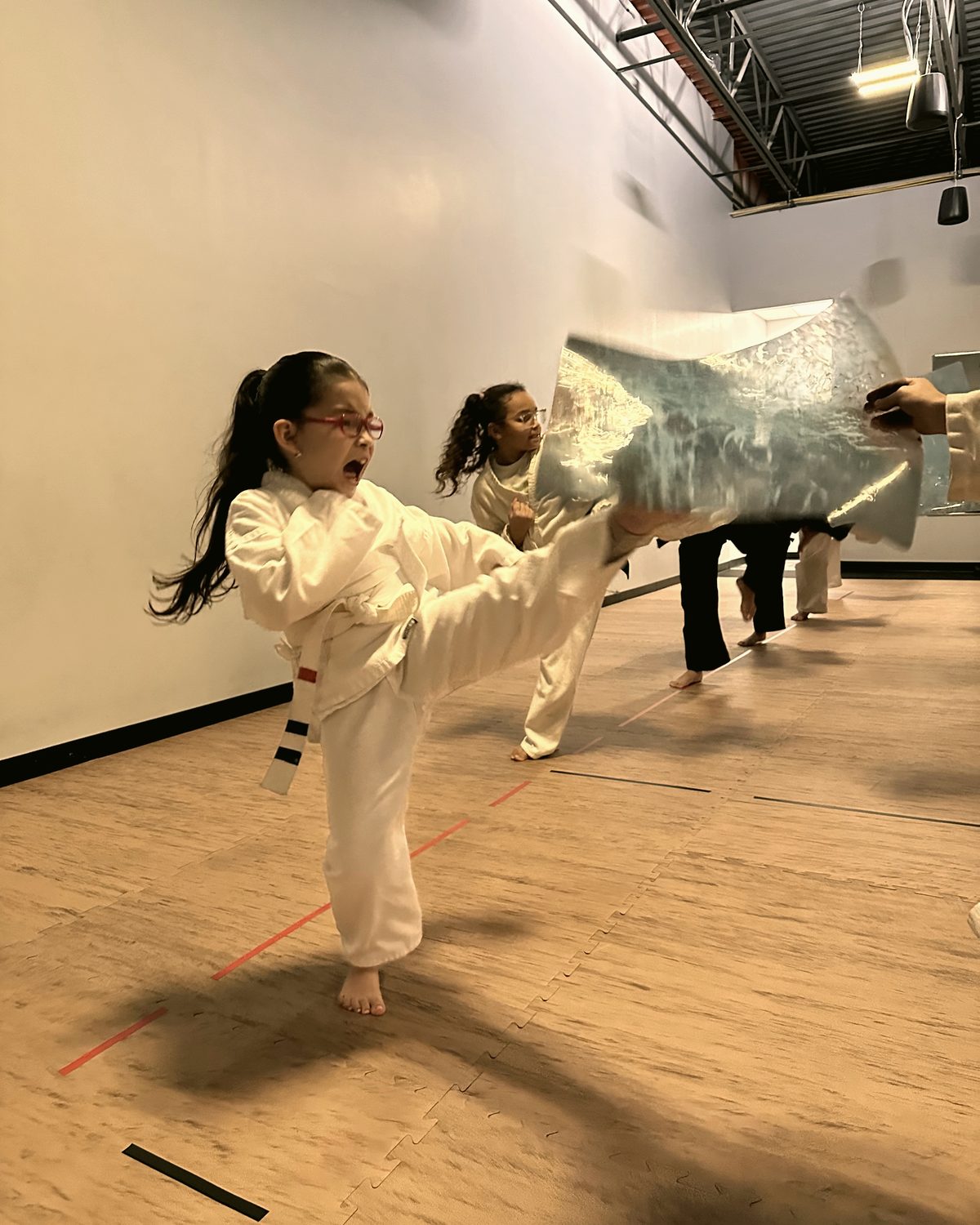
Parents often tell me some version of the same thing when their child starts karate:
He has a hard time focusing.
Sometimes they mean schoolwork. Sometimes they mean following directions. Sometimes their child can focus perfectly well on a video game for an hour but seems unable to listen to a 30-second instruction.
After more than 35 years in martial arts, I’ve come to think that we often misunderstand what focus actually is.
Focus isn’t simply sitting still.
For a child, focus means noticing what matters, listening long enough to understand what is being asked, controlling the impulse to do something else, and bringing their attention back when it wanders.
Those are skills.
And skills can be practiced.
Karate Gives Kids a Place to Practice Attention
I see this in class constantly.
I might demonstrate a combination and then ask students to perform it with a partner. To succeed, a student has to watch the demonstration, listen to the instructions, remember the sequence, control their body, pay attention to their partner, and make adjustments when something doesn’t work.
A few minutes later, the task changes.
Now we’re working on a form. Then a kicking drill. Then sparring. Each activity asks the student to direct their attention toward something slightly different.
The child who misses an instruction doesn’t need a lecture about having poor focus. We bring the student back to the task and try again.
That repetition matters.
Over the course of a class, a student may have dozens of opportunities to practice the same basic process:
- Listen.
- Remember.
- Do.
- Adjust.
- Repeat.
Over weeks, months, and years, that adds up to a lot of practice paying attention.
What Research on Martial Arts and Attention Has Found
My experience as an instructor is one thing. It becomes more meaningful when controlled research finds similar results.
A 2022 study published in Developmental Psychology followed 240 children between 7 and 11 years old. The children participated in either their normal physical education activities or an 11-week beginner Taekwondo program.
After the program, teachers rated the children who received martial arts training as having better attentional control. The researchers also found improvements in executive attention using a computerized attention task.
They did not find improvements in every area they measured, which is important. Martial arts isn’t a magic switch that suddenly changes every aspect of a child’s behavior. But the researchers concluded that even a relatively short introductory Taekwondo program improved aspects of attentional self-regulation.
More recently, a 2026 randomized controlled trial looked specifically at attention in 7- and 8-year-old children. Forty children were assigned either to regular physical education or to an eight-week structured Taekwondo program.
The children participating in Taekwondo showed greater improvement in attention stability and attentional shifting than the children participating in conventional physical education.
In practical terms, attention stability is the ability to stay with something. Attentional shifting is the ability to redirect attention when the situation changes.
Both happen repeatedly in martial arts.
This isn’t entirely new research, either.
In 2004, researchers Kimberley Lakes and William Hoyt studied 207 children from kindergarten through fifth grade. Students were assigned by classroom to either martial arts training or traditional physical education for three months.
The martial arts group showed greater improvements in areas including cognitive self-regulation, affective self-regulation, classroom conduct, and prosocial behavior.
The researchers described traditional martial arts as an environment where self-regulation is intentionally taught, modeled, practiced, and reinforced.
That last point is important.
Not All Activity Requires the Same Kind of Focus
Kids need physical activity. But karate asks something different of them than simply running around.
- A student may need to stand in a ready position without moving while instructions are given.
- Then move explosively when told.
- Then stop.
- Then remember three techniques in the correct order.
- Then perform them while controlling distance from another student.
- Then listen to a correction and immediately try again.
The body and brain are working together.
That doesn’t mean a child will suddenly become perfectly attentive after a few karate classes. I would be suspicious of anyone making that promise.
What I do expect is that a child will get repeated opportunities to practice being focused.
And that distinction matters.
Focus Includes Learning to Recover
One of the biggest misconceptions about focused kids is that they never become distracted.
Of course they do.
Adults do too.
A more useful skill is recognizing when attention has wandered and learning how to bring it back.
I’ve worked with plenty of students who needed frequent reminders when they first started training. They watched another student. They played with their belt. They started a technique before the instructions were finished.
The goal isn’t to punish every lapse in attention. The goal is to teach them how to recover from it.
- “Eyes here.”
- “Listen first.”
- “Try that again.”
- “Ready position.”
Those are small corrections, but they happen again and again.
Eventually, I can often say less.
The student begins making the correction independently.
That is progress.
Why Structure Matters at Fudoshin Martial Arts
At Fudoshin Martial Arts, we don’t expect focus to develop just because a child puts on a uniform and steps onto the mat. We build opportunities to practice it into the structure of class.
From the beginning, students learn simple routines: bow when entering the training area, stand in attention or ready position when instructed, listen before moving, keep their hands and feet controlled, and respond when an instructor is speaking.
As students progress, we expect more independence.
- Tie your own belt.
- Bring your equipment.
- Remember where to line up.
- Watch the demonstration before starting.
- Remember your form.
- Listen to a correction and try again.
- Control your technique while working with a partner.
Our six-week curriculum cycle reinforces this. Students repeatedly move between forms, combinations, sparring, self-defense, basics, review, and graduation preparation. Each part of training asks them to direct their attention in a slightly different way.
We also don’t award progress simply for showing up. In our Foundations Program, students earn curriculum stripes by demonstrating skills, and promotion depends on more than knowing the physical techniques. We also look at effort, focus, behavior, safety, and overall readiness for the next level.
That matters because focus shouldn’t depend on an adult standing nearby saying, “Pay attention.”
The long-term goal is for the student to begin managing that responsibility for themselves.
What Parents Should Expect at Fudoshin
When a parent enrolls a child at Fudoshin because focus is a concern, I don’t promise an overnight change.
During the first few classes, I’m looking at much smaller things.
- Can the student stand in attention position long enough to hear an instruction?
- Can they watch a demonstration before trying the technique?
- Can they remember two or three steps?
- When they become distracted, can they respond to a reminder and return to the task?
- Can they make a mistake, listen to a correction, and try again?
Those are meaningful signs of progress.
In our Foundations Program, new students usually earn their White Belt after approximately three to five classes. That first belt isn’t based on perfect karate. It represents something more basic: the student is beginning to understand class procedures, participate safely, follow instruction, and function successfully within the training environment.
From there, the expectations gradually increase.
By Gold and Green Belt, I want to see students becoming more consistent and independent. Not only performing better techniques, but listening more carefully, remembering more of their curriculum, controlling their bodies with partners, and taking greater responsibility for their own training.
Parents will still see distracted days. They will see difficult classes. They may occasionally see a child forget something they knew perfectly well the week before.
That’s normal.
The question I care about isn’t whether a child becomes distracted.
It’s whether they are getting better at coming back.
At Fudoshin Martial Arts, that’s one of the ways we measure growing focus: fewer reminders, faster recovery, better listening, and an increasing ability to take responsibility for the task in front of them.
Those changes are usually gradual.
But over months of consistent training, gradual changes can become habits.
Focus Is Something We Train
After more than three decades in martial arts and years of working directly with students, I don’t think focus is best understood as something a child either has or doesn’t have.
I’ve seen students who struggled to stay in line for 30 seconds eventually become students I could trust to work independently with a partner.
I’ve seen kids who constantly moved while I was talking gradually become the ones reminding themselves to stand ready and listen.
Those changes don’t happen because an instructor repeatedly tells a child to “focus.”
They happen because the child gets opportunities to practice it.
- Listen when someone else is speaking.
- Control your body when you’d rather move.
- Remember what you were shown.
- Stay with something when it becomes difficult.
- Notice a mistake.
- Accept a correction.
- Try again.
- And when your attention wanders, bring it back.
That’s what we’re really practicing.
Karate certainly isn’t the only way a child can develop those skills, and no responsible instructor should guarantee a particular outcome.
But a structured martial arts program can give a child hundreds of opportunities to practice them.
At Fudoshin Martial Arts, that is a major part of what training is supposed to accomplish.
Focus is not just something we ask students to have.
It’s something we train.
Research Cited
- Ng-Knight, T., Gilligan-Lee, K. A., Massonnié, J., Gaspard, H., Gooch, D., Querstret, D., & Johnstone, N. (2022). Does Taekwondo improve children’s self-regulation? If so, how? A randomized field experiment. Developmental Psychology, 58(3). https://doi.org/10.1037/dev0001307
- Song, X., Wang, D., et al. (2026). The effect of Taekwondo structured training on attention in 7–8-year-old children: a randomized controlled trial. BMC Sports Science, Medicine and Rehabilitation, 18, 130. https://doi.org/10.1186/s13102-026-01570-7
- Lakes, K. D., & Hoyt, W. T. (2004). Promoting self-regulation through school-based martial arts training. Journal of Applied Developmental Psychology, 25(3), 283–302. https://doi.org/10.1016/j.appdev.2004.04.002
Learn more about Kids Martial Arts, or call 763-388-0136.